

What Contract Manufacturing Actually Means: Who Owns the Output?

Why the distinction between supplying manpower and owning production performance matters as manufacturing scales.

A production line can be fully staffed and still miss its target.

There may be enough operators on the floor, enough supervisors on the roster and enough reports showing attendance. Yet takt time slips, rework builds up, defects travel downstream and output falls short.

That is where the difference between providing manpower services and owning manufacturing performance becomes clear.

In Layam’s model, contract manufacturing services involve taking responsibility for production execution: people, process, quality and performance, against an agreed output. The manufacturer provides the facility, materials, product technology and production targets. Layam takes responsibility for running the line and delivering the result.

For OEMs and industrial manufacturers scaling in India, that is a materially different proposition from manufacturing staffing.

Contract manufacturing is not another name for staffing
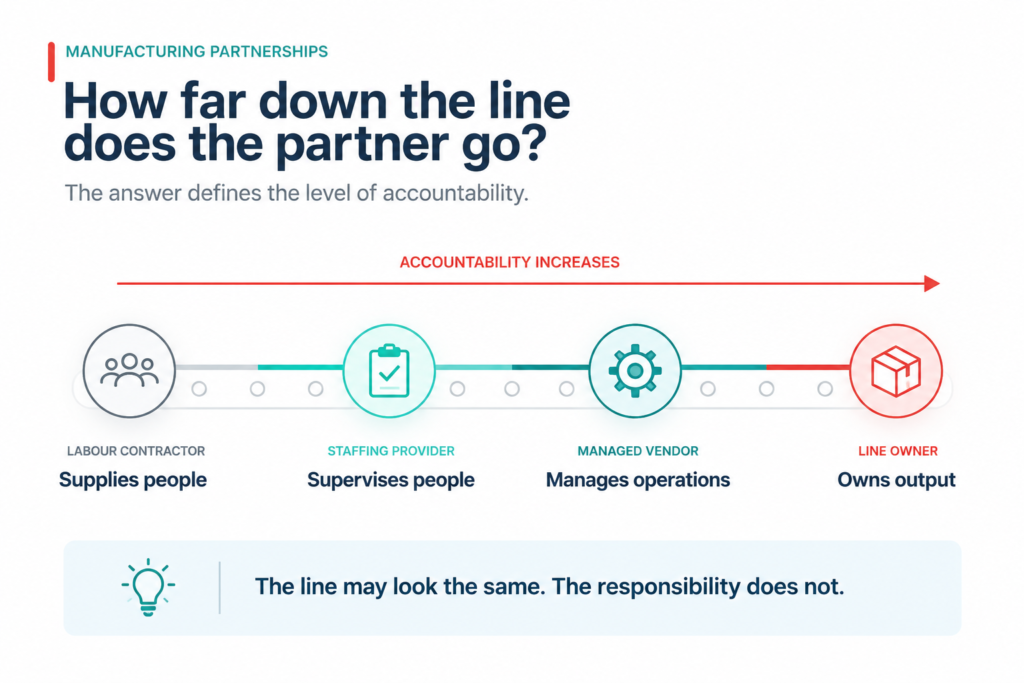
Manufacturing Partnerships Accountability Roadmap
Figure 1. How accountability travels further down the production line.

One reason the term causes confusion is that several different operating models are often grouped under the same label, even though a manpower supply service and an output-based manufacturing solution carry different responsibilities.

A labour contractor or manpower supply company primarily supplies workers. The manufacturer still manages production, process discipline and output. Contract staffing services may include workforce supervision and support for SOP compliance, but production quality generally remains the client’s responsibility. A managed manufacturing vendor takes greater process responsibility, often across a defined portion of the line.

A production line owner goes further: the partner takes end-to-end responsibility for line operations, workforce performance, quality control, reporting and output.

This distinction sits at the centre of Layam’s contract manufacturing positioning. Its operating split is simple: the client provides the plant; Layam delivers the output.

Why the old manpower model is under pressure

India’s manufacturing opportunity is expanding quickly. The country’s auto component industry reached approximately US$85.9 billion in FY2025-26, up 12.7% year on year, while EV components accounted for 4.6% of domestic OEM supplies. [Source: Economic Times Auto, original article]

Production growth creates another problem: finding people who can execute consistently. Nearly 80% of employers report difficulty finding skilled workers, while only 5-10% of factories in sectors such as automobiles, pharma and FMCG packaging are fully automated. [Source: Business Today, original article]

The ready-to-deploy talent pool is thin too. Deloitte India’s Blue-Collar Workforce Trends 2025 reports 5-7% attrition and a workbench rate of just 3%, alongside rising hiring intent for skilled blue-collar roles. [Source: Deloitte India, original report release]

Manufacturing recruitment and temporary staffing services can help fill workforce gaps. But adding headcount is not the same as adding manufacturing capacity. Someone still has to train operators, balance stations, monitor takt time, prevent defect recurrence and correct quality issues before they move downstream.

If the OEM continues to own all of that, it is using manpower outsourcing services, not outsourcing manufacturing. Labour outsourcing alone does not transfer responsibility for production.

What does “output-based” actually mean?

The difference becomes clearest in the commercial model.

Traditional industrial staffing services are usually priced around the number of people deployed. An output-based manufacturing model asks a more demanding question: What did the production line actually deliver?

Layam starts with a diagnostic baseline. Metrics such as Straight Pass Ratio, defects per vehicle and production performance are established before responsibility shifts. Minimum performance thresholds are agreed, and commercial terms are tied to output and quality outcomes rather than manpower alone. Layam describes the principle simply: “No Output. No Payment.”

That accountability needs visibility. Layam’s framework tracks production velocity, manpower availability, DPV, quality-gate performance and corrective actions. The aim is to show not only that a target was missed, but why it was missed and what happens next.

The governance case is broader than manufacturing. McKinsey has estimated that suboptimal contract terms and ineffective contract management can erode value equal to about 9% of annual revenue. It also found that more than 75% of contracts in its sample lacked a complete set of KPIs and reporting linked to total cost of ownership. [Source: McKinsey & Company, original article]

Zero defect cannot remain a slogan
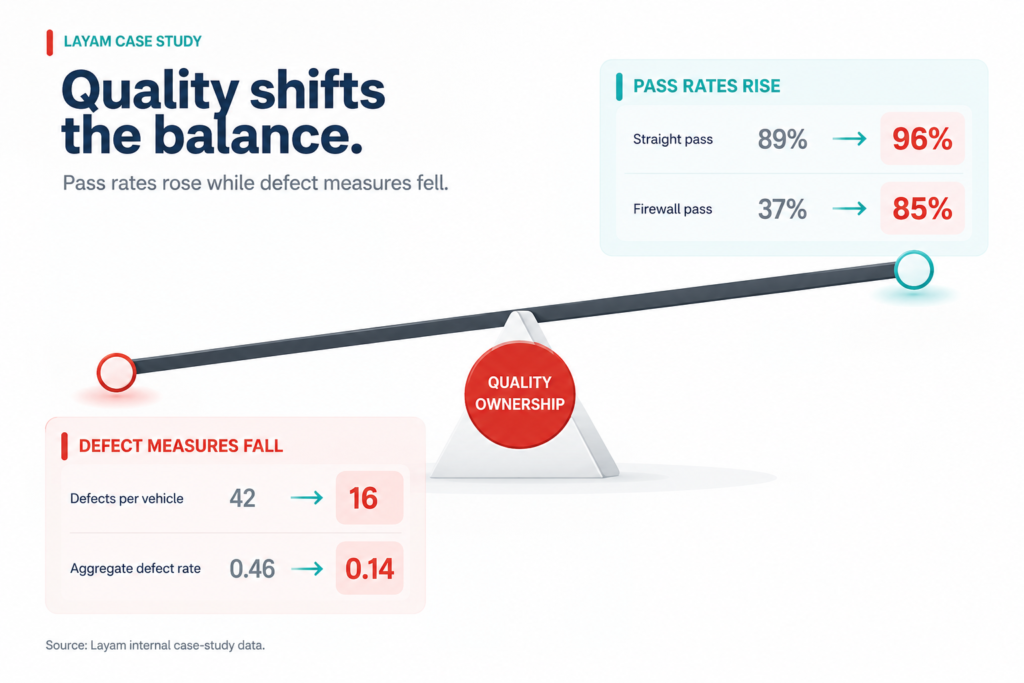
Quality Shifts the Balance
Figure 2. Quality ownership shifts the balance between pass rates and defects.

“Zero defect” is one of the easiest promises to make in manufacturing and one of the hardest to operationalise. Manufacturing excellence requires quality to be built into the process, not inspected only at the end.

In Layam’s model, that means stage-wise inspection, firewall quality gates, defect containment, root-cause analysis, Pareto-based prioritisation, corrective and preventive action, and feed-forward and feedback loops across the line.

The value of that approach becomes credible when it is expressed in production metrics. In one commercial vehicle engagement, Layam’s internal case-study data shows that Straight Pass Ratio improved from 89% to 96%. Firewall Pass Rate increased from 37% to 85%, DPV fell from 42 to 16, and the aggregate defect rate declined from 0.46 to 0.14.

In another chassis assembly programme, the pass ratio moved from 83% to 92%, alongside a zero-defect rollout and full CMVR compliance.

These are manufacturing outcomes, not workforce-placement metrics.

Production-line ownership changes the role of the partner

For the OEM, the objective is not necessarily to outsource the factory itself. The manufacturer can continue to own the infrastructure, materials, product design, technology and production strategy.

What changes hands is the operational responsibility required to convert those assets into reliable finished output. That can include stores and inbound logistics, parts quality assurance, shop-floor management, sub-assembly, main-line operations, quality inspection, end-of-line testing, PDI and continuous improvement.

Layam reports applying this model across LCV, M&HCV, EV bus and SUV lines, with 527 specialists deployed simultaneously for a leading commercial vehicle manufacturer.

That breadth matters as manufacturing complexity increases. EV platforms add safety-critical processes, high-voltage handling and additional quality controls, while faster launches and changing volumes make permanent capacity decisions harder. Manufacturing staffing services can help meet changing workforce needs, but the line still needs someone to own its performance.

A production partner therefore has to bring more than the labour availability expected of a staffing services company. It needs process discipline, measurable quality ownership and the ability to adapt without allowing performance to drift.

The question OEMs should ask

When evaluating a contract manufacturing company, the first question should not be: “How many people can you deploy?”

That still treats manufacturing as a headcount problem.

A better question is: “What part of the output are you prepared to own?”

That question reveals where responsibility actually sits when production falls short, quality deteriorates or volumes change.

The strongest contract manufacturing relationships are not defined by how many people enter the plant. They are defined by what comes off the line.

For manufacturers looking to scale without adding another layer of operational complexity, that is the distinction worth paying attention to.

Ready to hand over the line, not just the headcount? Layam’s contract manufacturing model is built around ownership of the output.

The Difficult Employee May Not Be the Problem. They May Be the Signal

Why workforce intelligence starts with diagnosing behavior before deciding how to manage it 

If a machine on a production line starts vibrating unexpectedly, no plant manager writes “difficult machine” in the root-cause analysis and moves on. 

    • We check the alignment.
    • We check the load. 
    • We check the process parameters, the raw material inputs, the operator setup, and the maintenance logs. 

Yet when a worker repeatedly questions an instruction, misses an output target, or bypasses a process, the conclusion is often immediate: 

Attitude problem. Difficult employee. Poor cultural fit. 

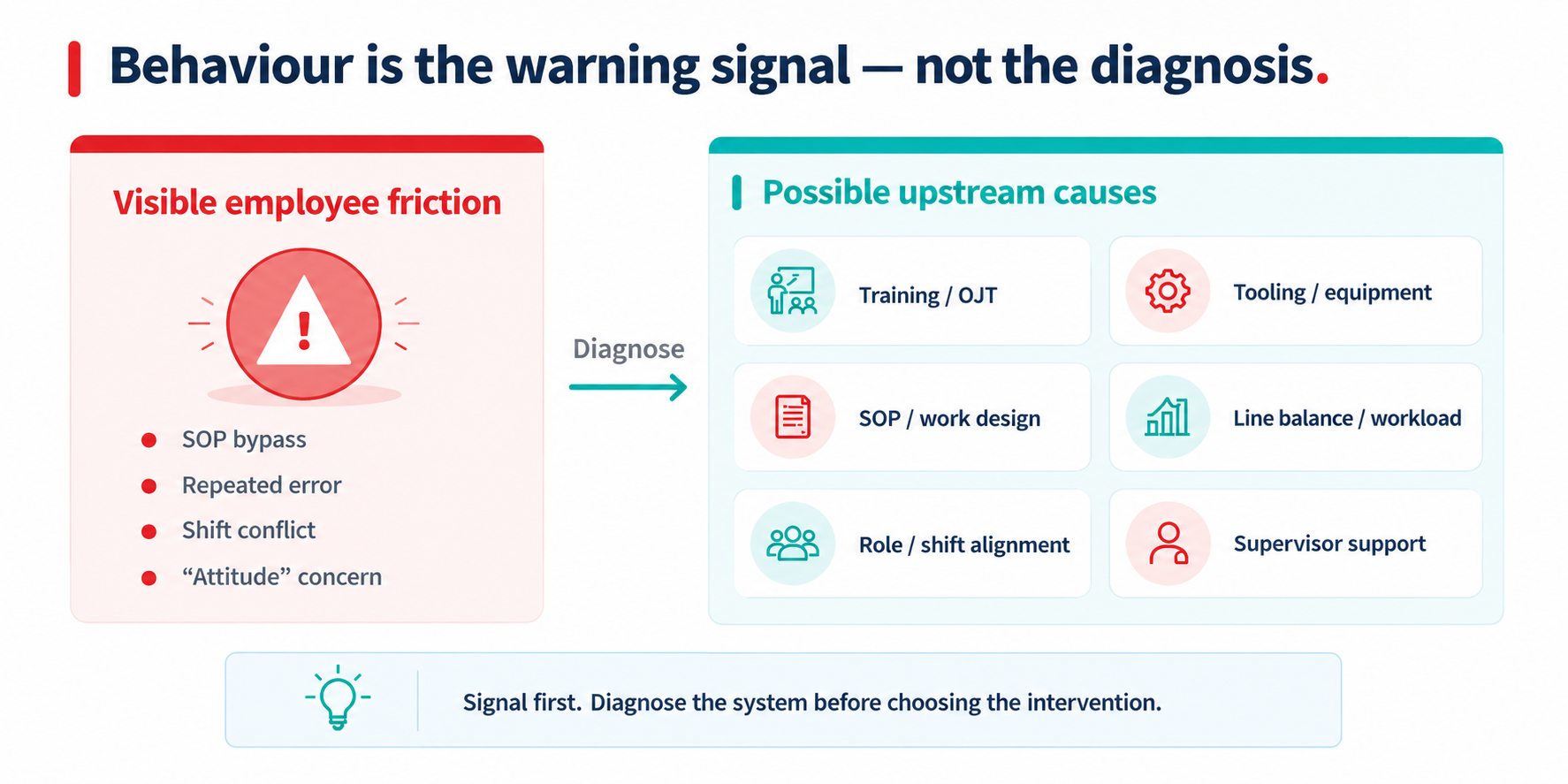
Sometimes, the behavior genuinely points to a conduct or capability issue. At other times, it is an early indicator of an upstream failure. Knowing the difference is where operational workforce intelligence begins. 


“Difficult” Is a Label. Not a Root Cause. 

Workplace friction on the shop floor is rarely just an isolated interpersonal issue. 

Research from Acas on workplace conflict found that capability and performance were the most common topic of conflict, cited by 38% of employees who experienced workplace conflict. (Source) 

Among managers reporting conflict with direct reports, 94% identified capability and performance as a topic of that conflict. (Source) 

Many situations categorized as “people problems” may stem from a more fundamental operational question: How is the work actually designed and supported? 

The observed behavior is the output. The root cause can sit upstream. 


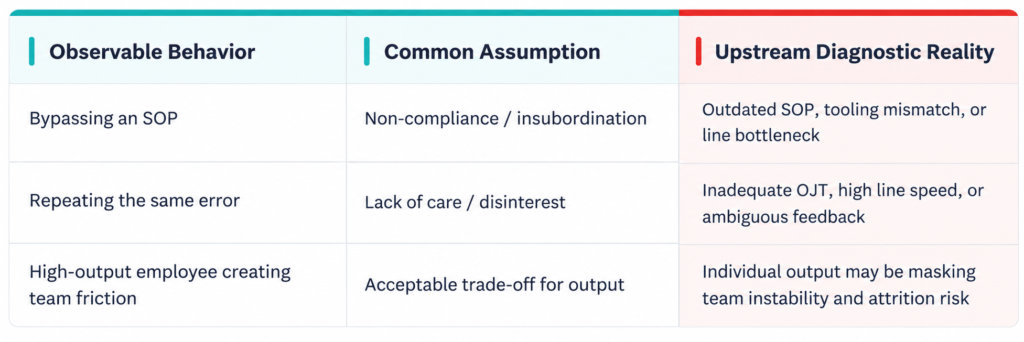
Three Common Shop-Floor Scenarios: Misconduct vs. System Friction 

1. The Operator Who Bypasses the SOP 

When an employee knowingly ignores a validated, safe, and practical Standard Operating Procedure, it is an accountability issue. 

Before issuing a disciplinary notice, check the pattern: 

    • Are multiple experienced operators using the same workaround? 
    • Does the documented SOP reflect actual line cycle times after recent engineering changes?
    • Has a tooling modification made the standard procedure impractical on shift? 

Resistance does not automatically justify non-compliance. But neither does an existing SOP prove that the process is working as intended. Intelligent operations determine which one is failing before taking action. 

2. The Worker Who Acknowledges Instructions but Repeats the Error 

A supervisor explains a task, the worker nods and confirms understanding, yet the defect recurs on the next run. It is easy to conclude that the worker does not care. 

In reality, identical visible errors can arise from entirely different operational breakdowns: 

    • Training Depth: Did they receive hands-on demonstration under real line speeds, or only classroom theory? 
    • Physical Ergonomics & Cognitive Load: Can the task be performed accurately given current cycle times and physical fatigue? 
    • Execution Choice: Are expectations clear, resources available, and the individual actively choosing not to adhere? 

The Diagnostic Rule: 

    • Training cannot solve deliberate misconduct. 
    • Discipline cannot solve a skill gap. 
    • Repeating an instruction cannot fix a broken process.

3. The “Star Performer” Disrupting Shift Cohesion 

Their individual numbers lead the board, but their presence destabilizes the shift. They hoard critical knowledge, dismiss newer operators, and create an environment where peers hesitate to flag defects. 

Protecting an individual because of high unit output reflects an incomplete performance metric. 

If one operator’s volume comes at the expense of team retention, cross-training, and shift stability, total line performance suffers. 

A manufacturing plant does not succeed on single-operator heroics; it succeeds on predictable system stability. 


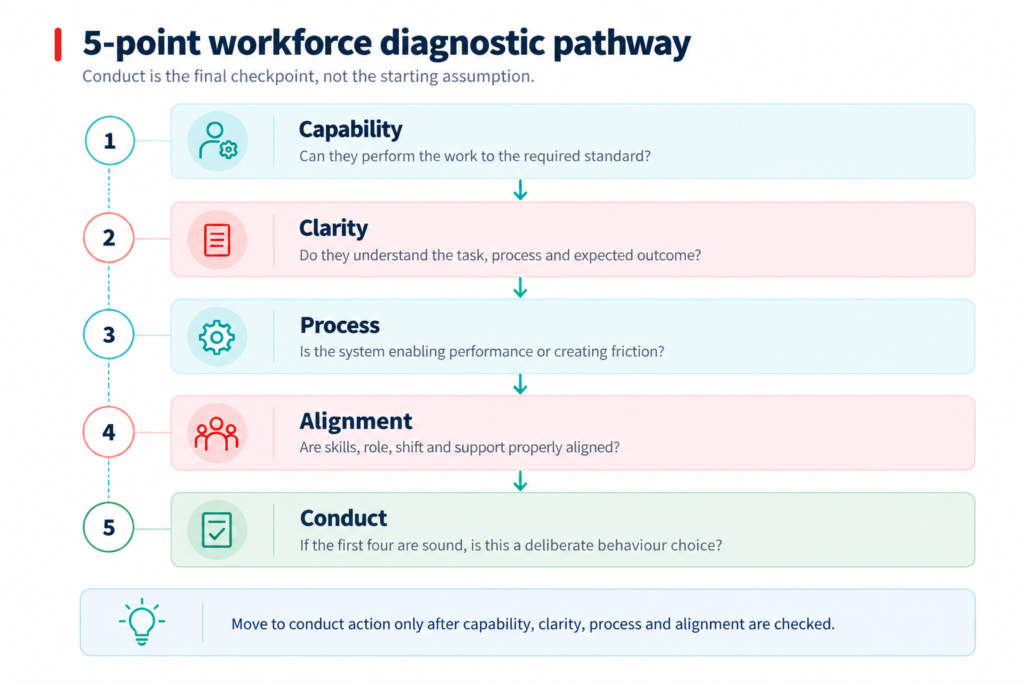
The 5-Point Workforce Diagnostic Framework 

Before deciding how to manage an individual, apply the same root-cause discipline used for quality defects: 

    1. Capability: Does the worker possess the verified, hands-on skill to hit quality and cycle benchmarks independently? 
    2. Clarity: Are task boundaries, quality tolerance limits, and operational priorities explicitly communicated? 
    3. Process: Is the production environment facilitating smooth execution, or forcing improvised workarounds? 
    4. Alignment: Are shift allocation, supervisory support, and physical station setups appropriately balanced? 
    5. Conduct: Once capability, clarity, process, and alignment are verified, is the individual deliberately choosing sub-standard behavior? 

Fluid Frontline Demographics Demand Better Diagnostics 

Precision diagnosis is increasingly important as manufacturing environments evolve toward higher automation, tighter tolerances, and more dynamic labor models. 

  • High Workforce Fluidity: Deloitte India’s Blue Collar Workforce Trends 2025 indicates that approximately 69% of blue-collar hires are temporary (Source), with an average tenure of 21 months (Source). Managing frequent onboarding cycles requires rapid, objective diagnostics rather than subjective assumptions. 
  • Frontline-Centric Productivity: The World Economic Forum report, Putting Talent at the Centre: An Evolving Imperative for Manufacturing (2025), emphasizes work design, talent planning, onboarding, development, effectiveness, and culture as important capabilities for frontline workforce stability and productivity. 

When workforces are dynamic, operational friction cannot be resolved through headcount replacement alone. It requires improving how people interface with operating processes. 


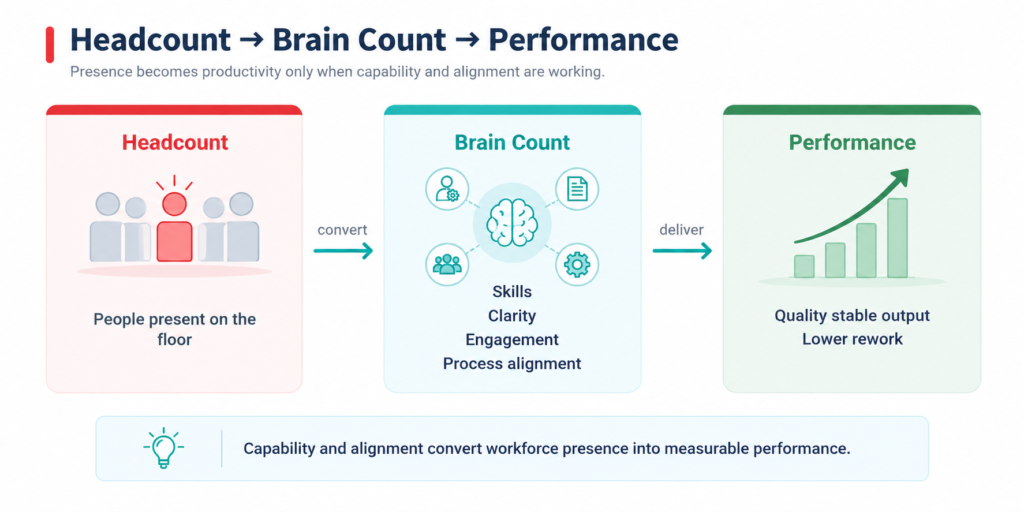
Moving from Headcount to Brain Count: People, Process, Performance 

Workforce intelligence is not just a software dashboard; it is the operational capability to interpret signals on the shop floor. 

Unplanned downtime, recurring rework, high absenteeism, and sudden attrition can be operational signals rather than isolated anomalies. A supervisor whose team consistently shows ‘attitude friction’ may be revealing an alignment bottleneck just as clearly as a temperature sensor flags an overheating motor. 

At Layam Group, we address operational stability by integrating People, Process, and Performance: 

  • Headcount measures how many workers are present on the floor. 
  • Workforce Intelligence evaluates what happens once they reach the station. 
  • Accountability ensures that process design, frontline capabilities, and line management align to deliver measurable output, reduced defects, and sustainable productivity. 

The next time an employee is flagged as “difficult,” treat the situation as an operational data point. The individual might need direct management – or they might be the first visible sign that an upstream process is breaking down. 


Key Takeaways for Operations Leaders 

How do you differentiate between an employee conduct issue and a process breakdown? 

Examine error patterns across the team. If multiple operators rely on identical workarounds or make similar errors at the same stage, the root cause may lie in process design, tooling mismatch, or unclear SOPs. If the issue remains isolated to one individual after training, resources, and expectations are verified, it points more strongly to an individual capability or conduct issue. 

What is workforce intelligence in manufacturing? 

Workforce intelligence in manufacturing connects frontline workforce behaviors – such as absenteeism, rework, process bypasses, and retention – with operational metrics such as cycle time, OEE, and defect rates. It shifts management from tracking passive headcount to improving active capability, process alignment, and measurable performance. 

Why is root cause analysis necessary for frontline performance issues? 

Applying disciplinary action to a skill gap or broken SOP does not resolve the underlying production problem. Root cause analysis helps match the intervention to the actual issue: training for capability gaps, process correction for broken workflows, and disciplinary measures for genuine conduct violations.

×

Please Fill the Details below will share the required document to your email.