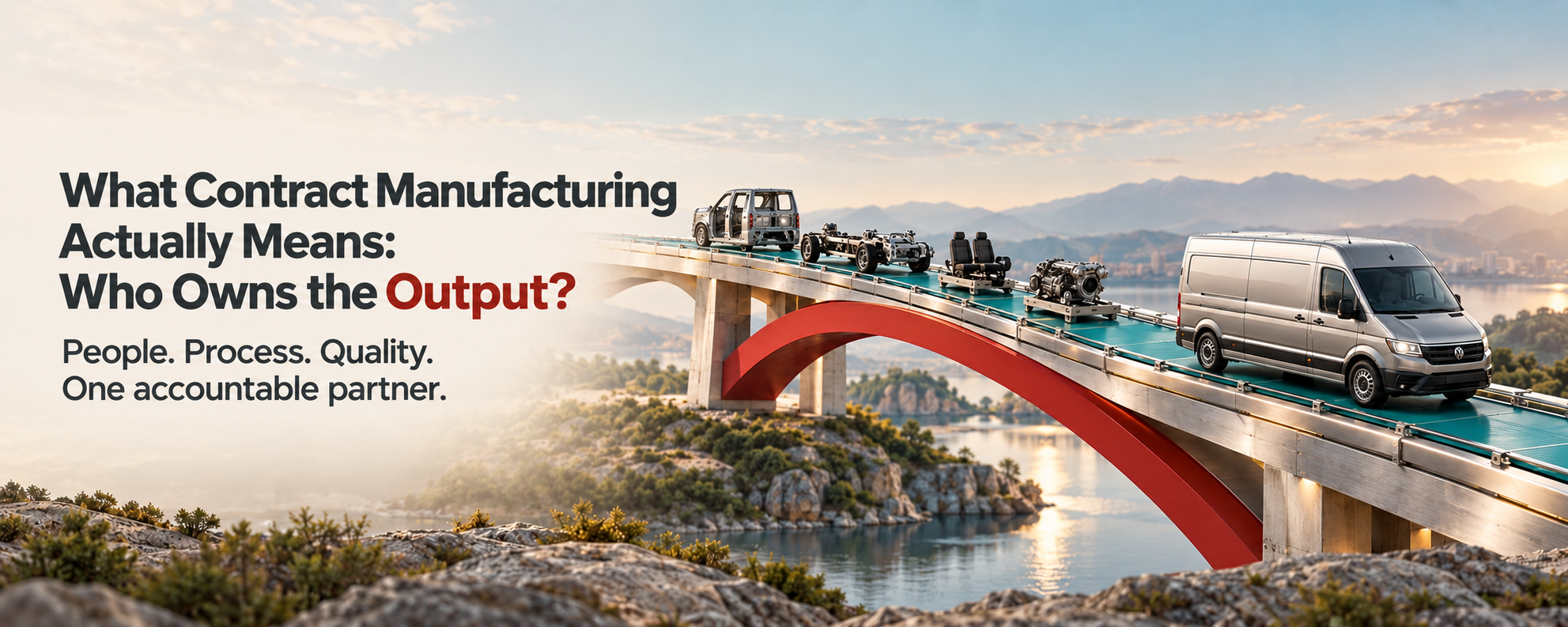
Why the distinction between supplying manpower and owning production performance matters as manufacturing scales.
A production line can be fully staffed and still miss its target.
There may be enough operators on the floor, enough supervisors on the roster and enough reports showing attendance. Yet takt time slips, rework builds up, defects travel downstream and output falls short.
That is where the difference between providing manpower services and owning manufacturing performance becomes clear.
In Layam’s model, contract manufacturing services involve taking responsibility for production execution: people, process, quality and performance, against an agreed output. The manufacturer provides the facility, materials, product technology and production targets. Layam takes responsibility for running the line and delivering the result.
For OEMs and industrial manufacturers scaling in India, that is a materially different proposition from manufacturing staffing.
Contract manufacturing is not another name for staffing
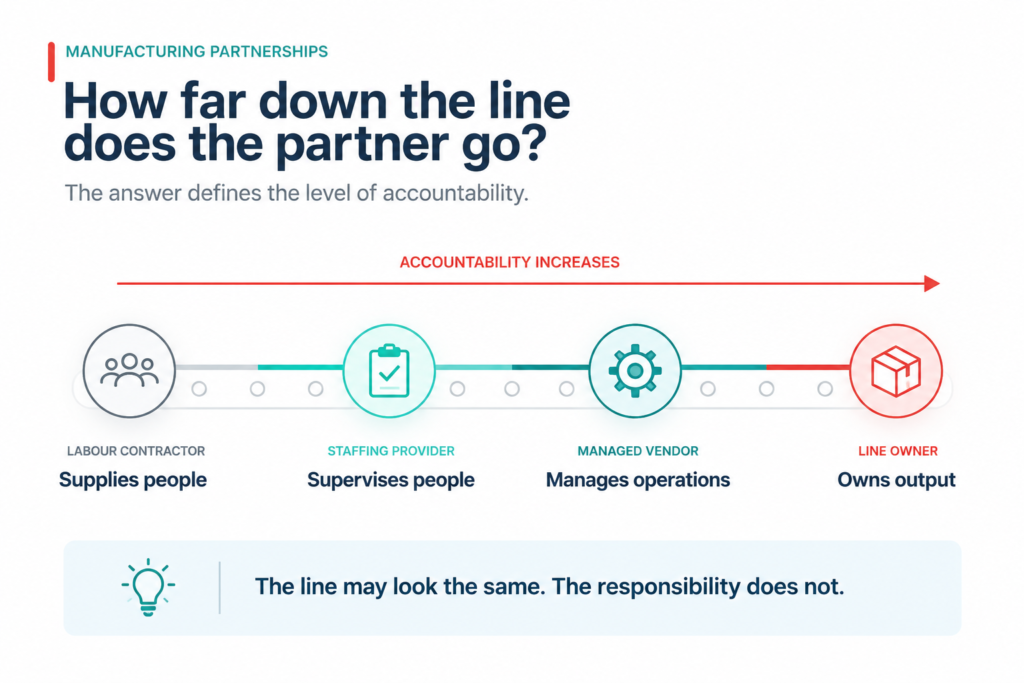
One reason the term causes confusion is that several different operating models are often grouped under the same label, even though a manpower supply service and an output-based manufacturing solution carry different responsibilities.
A labour contractor or manpower supply company primarily supplies workers. The manufacturer still manages production, process discipline and output. Contract staffing services may include workforce supervision and support for SOP compliance, but production quality generally remains the client’s responsibility. A managed manufacturing vendor takes greater process responsibility, often across a defined portion of the line.
A production line owner goes further: the partner takes end-to-end responsibility for line operations, workforce performance, quality control, reporting and output.
This distinction sits at the centre of Layam’s contract manufacturing positioning. Its operating split is simple: the client provides the plant; Layam delivers the output.
Why the old manpower model is under pressure
India’s manufacturing opportunity is expanding quickly. The country’s auto component industry reached approximately US$85.9 billion in FY2025-26, up 12.7% year on year, while EV components accounted for 4.6% of domestic OEM supplies. [Source: Economic Times Auto, original article]
Production growth creates another problem: finding people who can execute consistently. Nearly 80% of employers report difficulty finding skilled workers, while only 5-10% of factories in sectors such as automobiles, pharma and FMCG packaging are fully automated. [Source: Business Today, original article]
The ready-to-deploy talent pool is thin too. Deloitte India’s Blue-Collar Workforce Trends 2025 reports 5-7% attrition and a workbench rate of just 3%, alongside rising hiring intent for skilled blue-collar roles. [Source: Deloitte India, original report release]
Manufacturing recruitment and temporary staffing services can help fill workforce gaps. But adding headcount is not the same as adding manufacturing capacity. Someone still has to train operators, balance stations, monitor takt time, prevent defect recurrence and correct quality issues before they move downstream.
If the OEM continues to own all of that, it is using manpower outsourcing services, not outsourcing manufacturing. Labour outsourcing alone does not transfer responsibility for production.
What does “output-based” actually mean?
The difference becomes clearest in the commercial model.
Traditional industrial staffing services are usually priced around the number of people deployed. An output-based manufacturing model asks a more demanding question: What did the production line actually deliver?
Layam starts with a diagnostic baseline. Metrics such as Straight Pass Ratio, defects per vehicle and production performance are established before responsibility shifts. Minimum performance thresholds are agreed, and commercial terms are tied to output and quality outcomes rather than manpower alone. Layam describes the principle simply: “No Output. No Payment.”
That accountability needs visibility. Layam’s framework tracks production velocity, manpower availability, DPV, quality-gate performance and corrective actions. The aim is to show not only that a target was missed, but why it was missed and what happens next.
The governance case is broader than manufacturing. McKinsey has estimated that suboptimal contract terms and ineffective contract management can erode value equal to about 9% of annual revenue. It also found that more than 75% of contracts in its sample lacked a complete set of KPIs and reporting linked to total cost of ownership. [Source: McKinsey & Company, original article]
Zero defect cannot remain a slogan
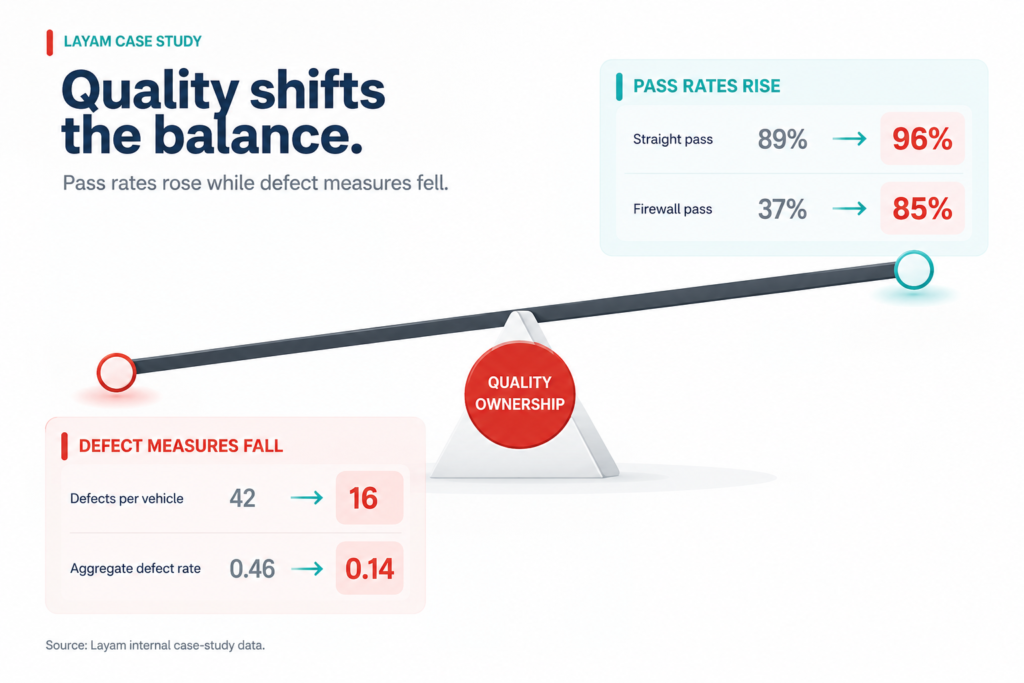
“Zero defect” is one of the easiest promises to make in manufacturing and one of the hardest to operationalise. Manufacturing excellence requires quality to be built into the process, not inspected only at the end.
In Layam’s model, that means stage-wise inspection, firewall quality gates, defect containment, root-cause analysis, Pareto-based prioritisation, corrective and preventive action, and feed-forward and feedback loops across the line.
The value of that approach becomes credible when it is expressed in production metrics. In one commercial vehicle engagement, Layam’s internal case-study data shows that Straight Pass Ratio improved from 89% to 96%. Firewall Pass Rate increased from 37% to 85%, DPV fell from 42 to 16, and the aggregate defect rate declined from 0.46 to 0.14.
In another chassis assembly programme, the pass ratio moved from 83% to 92%, alongside a zero-defect rollout and full CMVR compliance.
These are manufacturing outcomes, not workforce-placement metrics.
Production-line ownership changes the role of the partner
For the OEM, the objective is not necessarily to outsource the factory itself. The manufacturer can continue to own the infrastructure, materials, product design, technology and production strategy.
What changes hands is the operational responsibility required to convert those assets into reliable finished output. That can include stores and inbound logistics, parts quality assurance, shop-floor management, sub-assembly, main-line operations, quality inspection, end-of-line testing, PDI and continuous improvement.
Layam reports applying this model across LCV, M&HCV, EV bus and SUV lines, with 527 specialists deployed simultaneously for a leading commercial vehicle manufacturer.
That breadth matters as manufacturing complexity increases. EV platforms add safety-critical processes, high-voltage handling and additional quality controls, while faster launches and changing volumes make permanent capacity decisions harder. Manufacturing staffing services can help meet changing workforce needs, but the line still needs someone to own its performance.
A production partner therefore has to bring more than the labour availability expected of a staffing services company. It needs process discipline, measurable quality ownership and the ability to adapt without allowing performance to drift.
The question OEMs should ask
When evaluating a contract manufacturing company, the first question should not be: “How many people can you deploy?”
That still treats manufacturing as a headcount problem.
A better question is: “What part of the output are you prepared to own?”
That question reveals where responsibility actually sits when production falls short, quality deteriorates or volumes change.
The strongest contract manufacturing relationships are not defined by how many people enter the plant. They are defined by what comes off the line.
For manufacturers looking to scale without adding another layer of operational complexity, that is the distinction worth paying attention to.