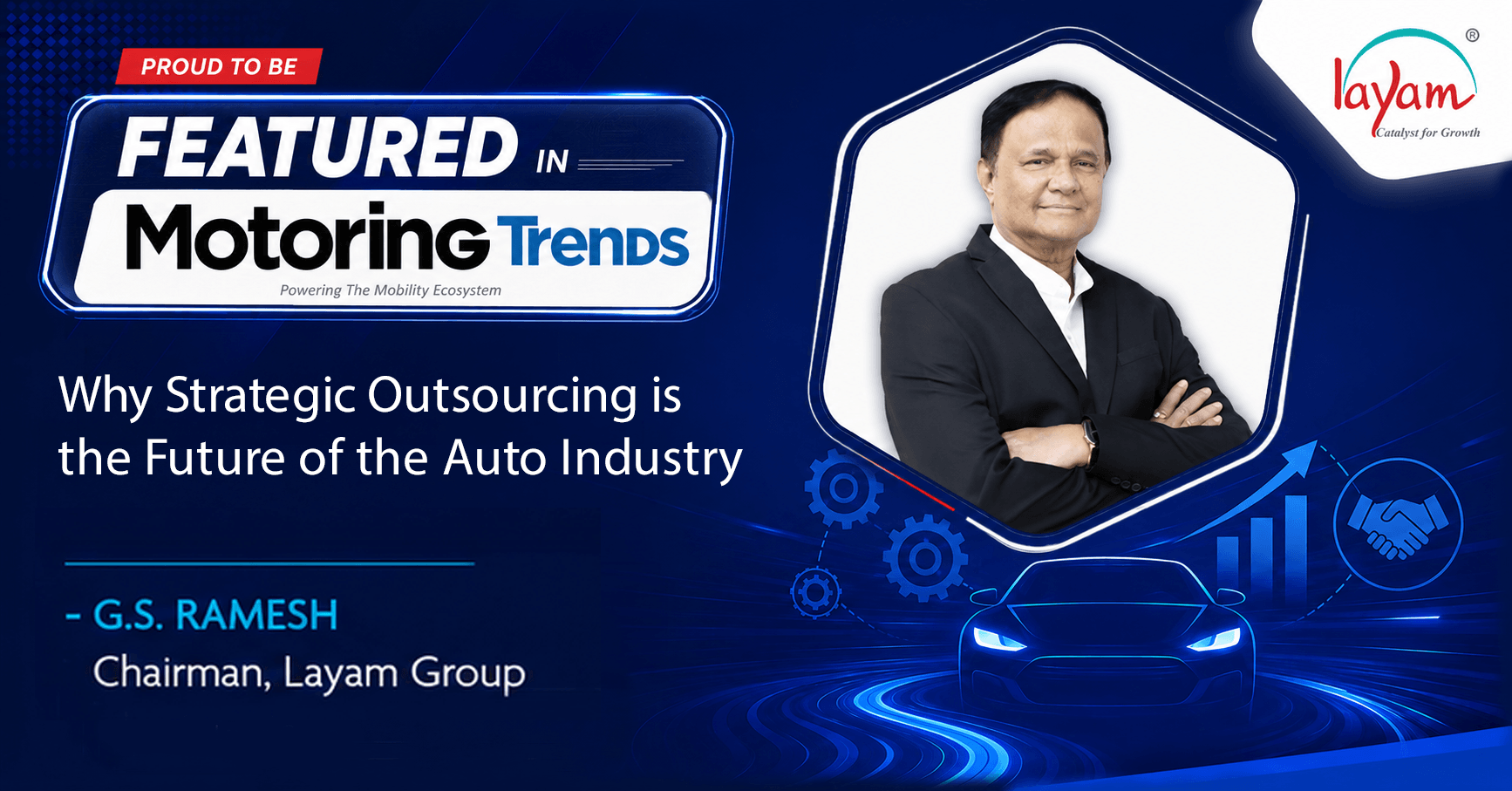
Why Strategic Outsourcing is the Future of the Auto Industry

[ As published in Motoring Trends : Vol No: 7 Issue No: 4 July-August 2026]

Contract manufacturing is rapidly evolving from a cost-saving tool into a strategic necessity for automotive OEMs as companies seek greater flexibility, specialised skills and operational resilience amid industry-wide transformation.

India’s automotive industry is entering a new era where strategic outsourcing, contract manufacturing and workforce solutions will increasingly become integral to how original equipment manufacturers (OEMs) operate, according to Layam Group Chairman G S Ramesh.

Speaking about the changing dynamics of automotive manufacturing exclusively with Motoring Trends, Ramesh said the industry’s transition from conventional vehicle production to electrification coupled with persistent cost pressures has accelerated the adoption of contract manufacturing models across the sector.

“India’s automobile industry is going through a unique transition phase. First there was the shift from conventional technologies, then the aggressive push towards electric vehicles followed by market fluctuations and uncertainty. In such an environment, OEMs are constantly looking at costs and human resources become one of the key areas where optimisation is possible,” Ramesh said.

According to him, modern contract manufacturing extends far beyond providing manpower and has evolved into an output-driven business model where service providers assume operational responsibility for specific manufacturing functions.

“Contract manufacturing is not simply about supplying headcount. It is about taking end-to-end responsibility for delivery. If an OEM expects a particular output, we must ensure it is achieved. Today, resource management and productivity enhancement are among the biggest challenges for manufacturers and they prefer partners who are willing to take ownership of these areas,” he explained.

Layam currently employs approximately 15,000 people and operates across nearly 60 locations nationwide.

Its footprint extends from Pantnagar in Uttarakhand to Chennai in Tamil Nadu, covering most of India’s major industrial hubs.

“We always prioritise local talent where possible. However, if specialised skills are unavailable, we mobilise resources from across India. In our organisation, you will find employees from West Bengal, Odisha, Jharkhand, Arunachal Pradesh and many other states,” noted Ramesh.

The company currently works primarily with OEMs and tier-I suppliers, although it has begun engaging tier-II suppliers and MSMEs to introduce them to its operating model.

At the heart of Layam’s approach is what Ramesh describes as a ‘20:80 model’.

Under this framework, OEMs contribute technology, infrastructure and capital investment, while Layam assumes responsibility for workforce mobilisation, execution and operational delivery.

“The OEM may have excellent technology and infrastructure but somebody still has to deliver the output. Our role is to provide the critical mass of skilled resources required to execute that vision efficiently,” he said.

The model also allows manufacturers to reduce long-term workforce liabilities while maintaining operational flexibility.

“If OEMs hire everyone directly, the costs continue to accumulate through salary increments, benefits and long-term obligations. Under a contract manufacturing model, resources can be redeployed as projects evolve. It eliminates the cascading effect of long-term liabilities while ensuring delivery,” Ramesh noted.

He added that strategic outsourcing also helps OEMs manage compliance and workforce administration more effectively.

“From statutory compliance to resource management, there is a comfort level when a specialised partner is handling these responsibilities,” the industry veteran noted.

While some industry observers have raised concerns that contract manufacturing could eventually replace traditional employment within OEMs, Ramesh believes the future lies in collaboration rather than replacement.

“We are one part of the OEM ecosystem. We do not become the entire system,” he said.

However, he expects the role of outsourcing partners to expand significantly over the coming years.

“Today, the balance between in-house operations and outsourced activities may be around 60:40 or 70:30. Over time, it could move closer to 50:50. Strategic outsourcing is going to become one of the defining trends of the future,” he stated.

Looking ahead to 2030, Ramesh believes three factors will drive this transformation, namely cost, competence and consistency.

“Every OEM is under pressure to control costs. At the same time, finding and retaining skilled talent is becoming increasingly difficult. Consistency in quality also requires access to the right people and capabilities. Strategic outsourcing addresses all three challenges,” he contended.

Although contract manufacturing is often associated with production activities, Ramesh said the model is increasingly extending into engineering and research functions.

“Many people assume research and development remains entirely in-house but even these centres frequently utilise specialised talent supplied by third parties. We have supported organisations with highly specialised resources,” Ramesh observed.

At the same time, tangible production activities continue to represent the largest growth area for contract manufacturing.

Layam is currently involved in electric and conventional bus manufacturing projects for Tata Motors while also supporting operations at Ashok Leyland and conducting third-party quality inspections for multiple OEMs.

The company additionally manages supply chain operations, warehouse management, fabrication, welding, shell-building activities, paint shop operations and quality control assignments across various industrial sectors.

“We focus on process ownership and operational delivery rather than simply supplying manpower,” Ramesh said.

As India’s electric vehicle industry expands, workforce requirements are evolving rapidly.

Ramesh believes the shift presents significant opportunities for organisations capable of developing specialised skills.

“EV manufacturing is fundamentally different from conventional vehicle production. Areas such as wiring harnesses are becoming increasingly important,” he stated.

Layam has established partnerships with educational institutions and universities to support EV-focused training programmes and address the needs.

“We work closely with academic institutions to help develop relevant curricula and ensure graduates are industry-ready before entering projects,” he said.

The company also supports operations for major suppliers serving EV manufacturers including Japanese companies and leading component manufacturers.

Ramesh identified compliance management as one of Layam’s strongest differentiators.

With increasing scrutiny around EPFO, ESIC, workplace safety and labour regulations, he said companies can no longer afford compliance lapses.

“Execution excellence and statutory compliance are our biggest strengths,” he said.

Layam has invested heavily in digital systems that manage employee onboarding, workforce administration and compliance monitoring across all operating locations.

The company also operates a centralised control system from Chennai and maintains a dedicated compliance team.

“We have introduced a 24-hour employee helpline. Any worker facing an issue can contact us directly and we ensure that concerns are addressed quickly,” he contended.

The company additionally provides post-employment support for provident fund settlements and assists families in securing benefits following employee deaths.

Despite widespread concerns about workforce attrition, Ramesh believes retention is ultimately driven by trust and employee welfare rather than compensation alone.

“The younger generation has different expectations. They want faster growth and immediate outcomes, which naturally contributes to higher attrition,” he explained.

However, he believes organisations can build loyalty by addressing employees’ fundamental concerns.

“If you take care of three things, that is food security, medical support and family wellbeing, then people will remain loyal,” he noted.

Layam’s employee welfare initiatives include healthcare support, family assistance programmes and, in some cases, financial assistance for children’s education.

Much of Layam’s culture appears to stem directly from Ramesh’s personal management philosophy shaped during his two decades with the Tata Group.

The chairman maintains an open-door policy and encourages employees at all levels to approach him directly.

This philosophy also influences the company’s approach towards contract workers.

Layam’s entry into contract manufacturing began in 2023 after years of operating as an HR consulting and workforce solutions provider.

According to Ramesh, the move emerged from a desire to create greater value for both employees and customers.

“Our original mission was to hire, train and deploy talent. Over time, I asked myself why we couldn’t convert that brain power into direct operational value,” he contended.

The decision has paid off.

“Contract manufacturing has been a major growth catalyst for us. We are currently growing at around 20 percent annually,” he stated.

As India’s automotive industry navigates electrification, cost pressures and workforce transformation, companies like Layam are positioning themselves not merely as staffing providers but as strategic partners embedded within the manufacturing ecosystem.
Share this:

Auto Hiring Shift to Software and EV Skills

If you have been following the automotive world lately, you already know the shift is happening fast. Cars are no longer just mechanical machines, they are sophisticated computers on wheels powered by software, advanced electronics, and electric powertrains.

But as tech speeds ahead, a quieter challenge is unfolding across assembly lines and engineering hubs: the job-readiness gap.

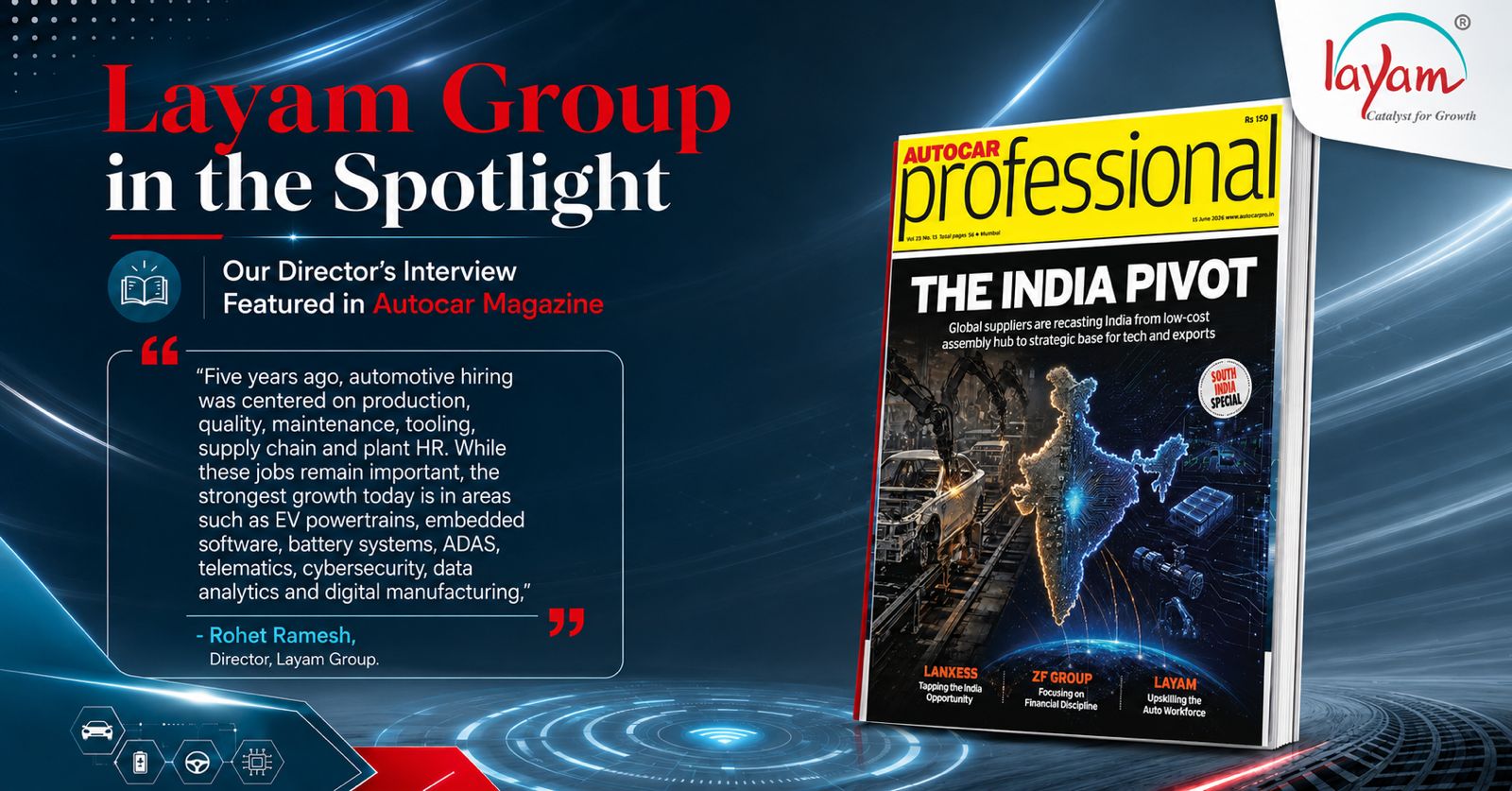
In a recent interview with Autocar Professional, our Director, Rohet Ramesh, broke down what this shift means for businesses, engineering talent, and the future of mobility.

Here is a quick look at the key takeaways and what they mean for your organization.

1. The Skills Horizon Has Shifted

The traditional mechanical framework that built the automotive industry for decades is no longer enough on its own. Today, the demand has shifted dramatically toward specialized disciplines:

  • Embedded Software & Electronics
  • EV Powertrains & Battery Management Systems
  • Advanced Driver Assistance Systems (ADAS)

While engineering institutions graduate thousands of bright young minds each year, the tech ecosystem is moving faster than classroom curriculums can adapt.

2. Mind the “Job-Readiness” Gap

It is not that talent does not exist, it is that traditional training often stops at theory.

When dynamic changes happen in real-time, new graduates and experienced engineers alike face a steep learning curve before they can deliver on live projects. Bridging this gap requires moving beyond static skill sets and preparing people for immediate, real-world deployment.

3. Upskilling Is No Longer Optional

So, how do we solve this?

As Rohet highlights in the feature, the answer lies in proactive reskilling and stronger partnerships between industry and academia. Companies that invest early in structured upskilling programs do not just fill empty seats, they build resilient teams capable of steering through the next decade of innovation.

Read the Full Feature

Want to dive deeper into the strategies shaping tomorrow’s automotive workforce?

Read the Full Director Interview in Autocar Professional Here: Auto Hiring Shift to Software and EV Skills

Share this:

EX EMPLOYEES ARE OUR BIGGEST CHEERLEADERS!

Layam Group is not a company in the true sense, it’s an institution which strongly believes in intellectual growth. In fact, you can call Layam a ‘Gurukul’. We have created a strategy for Cost, Quality and productivity with an emphasis on People, Process and Performance. We have emerged as the Catalyst for Growth for many companies and our employees alike. Our pioneering concept of head count to brain count has benefited over 15,000 people who have moved ahead on their career path thanks to our upskilling process of making them ‘industry ready’.  Likewise, our employees too view Layam as the perfect training ground to hone their skills. From a trainee executive to HODs, we make sure that learning process does not cease. Most of our employees who have moved on to other companies have left on a positive note. Employees may have chosen to move on for various reasons like family or health issues or a better opportunity, but each one of them have left Layam with a positive outlook. Our ex-employees have openly expressed that they feel enriched by the knowledge and confidence they have gained by working in Layam. Needless to say, all ex Layamites continue to stay in touch with us and yearn to come back to Layam one day.

We can proudly say that HR as a partner in progress is a concept that we have successfully implemented amongst our stakeholders and our ex-employees too!  Today, our ex-employees have emerged as the true brand ambassador of Layam as they play an important role in our recruiting and branding strategy. As the importance of relationships and networking gains momentum, Layam has successfully showcased that creating and nurturing the network of ex-employees is a step in the right direction.

Share this:

IS CORONA MENACE LEADING TO A NEW DIMENSION IN THE HIRING WORLD?

Job market and hiring have become very buoyant. In the present scenario, the Human Resource which we always have been proud of has replaced its stature from ‘Resource’ to ‘Commodity’. The Corona effect and the ensuing Work from Home concept has given rise to a new dimension in the hiring world. Today’s Human Resource is trying to make the best of this situation like the old proverb “Make Hay when the sun shines”. However, it may have a cascading effect on their career which will ultimately lead them to nowhere. Let me elucidate this with an example, If a person is drawing Rs. 10,000/- CTC  and is suddenly offered a hike of Rs.40,000/- CTC, he will obviously be very happy with the huge jump in his salary but this may lead to disastrous consequences. Not all may go through this but majority will be Sufferers than Gainers in the system such as:

1)  Entire job market compensation structure will have a tremor effect and an added escalation in cost to the Employer

2)  The Employer has to run his business so he may not mind to take such temporary shocks but when the market eventually settles down, it leads to another cycle of clipping which will have a dreadful effect on the high-cost resource

Here, the employer is not at fault because he would like to have a low cost, high yield strategy at the right time.

 Now, what happens to the Resource?

After getting this enormous hike, his personal expectations and standard of living will obviously go up. He becomes a favorite customer of the bank who allures him for long term EMIs!

The sudden change in standard of living creates a mindset change for kids and other family members. However, if something untoward happens and the Resource is not able to manage the situation, the entire family is bound to suffer mental agony and depression.

Is it necessary? -This question often comes to my mind

In a way all of us are responsible for this debacle! In some countries, they have put a ban that the increment should not be more than 40% to 50%. There is an urgent need for us to introspect and ensure that the compensation structure of the country which also impacts the economy is not bulldozed without any justification.

The mental and social health of our resources has to be protected. We should not let them fall prey to this damaged system that is prevalent today. Industrial bodies and Government alike must also make a note of this and ensure equilibrium so that a healthy and stable system can be maintained. Then, I’m sure the economy of our country will be strong and stable in the true sense.

There may be several people who may find my thought process weird. But I urge you to sit back, analyze and think about the future. We have to get sensitized with what is happening around us, be it in the pretext of corona or otherwise.

Share this:

NO RISK, NO GAIN!

I am probably the best example for the adage Old wine in a new bottle. Just as the wine gets older, it becomes more expensive. Similarly, at the age of 67, I feel eager to work harder and contribute to the society. This passion towards work can be traced back to my first job with TATAs. I was interviewed by none other than the great Russi Mody, a legend who was instrumental in building TATA iron and steel company. In the interview, he asked me where do you want to work? Steel or Coal mines? I choose coal. He was completely taken aback by my answer, probably wondered how a boy from South India could sustain working in a tough terrain like coal mines. His next question was, “Where do you want to end?”. I simply replied, I want to sit in the chair where you are sitting. He just smiled and said, “What nonsense”, but I assured him about my goal and thus began my 20 years journey with TATAs. I first started with coal and then moved to steel. Later on, I set up a cement plant and after few years I was picked up by Hyundai as their Sr. Vice President HR. I worked in this Korean company for over 12 years and finally retired from my first innings.

In my second innings, I decided to achieve my passion. My inner passion has always been to give back to society. I always believed that if I am able to help others achieve their dreams, it will make me a happy and an enriched person. I started practicing this. I created an institution with an intention to help school and college dropouts. As Layam opened its doors in 2007, we soon realized that there are scores of candidates with poor academic records but exemplary skills (either technical or life skills). We stepped in as a catalyst for growth. Thus began my dream of helping others achieve their dreams.

Candidates coming to us are trained and upskilled. Later on, we place them in leading companies wherein they start their journey toward career success. Today, I am proud to say that we have trained and placed over 15,000 people in various jobs across India and there are many more who are coming into our fold. Today, my institution has a pan India presence. At times, I sit back and think, ‘Have I really earned my salary and for what am I working’, then I recall my father’s words. He said, “before you get a job, think about what is your contribution to the society?” My contribution to the society may be a drop in the ocean but when I see successful candidates fulfilling their career dreams, it fills me with immense joy and satisfaction.

I have always believed that developing empathy is an essential trait which I have tried to imbibe in every step of my life’s journey. While doing so, I have refrained from embracing a stance like, I am okay but you are not okay. This ego trip can become an ongoing phenomenon with no clear solutions in sight. Instead, try to enjoy the simple pleasures in life and do everything with your heart. God has given us head and heart. Do not dump all your negative feelings and emotions into your heart. Instead, use your head to filter it. The most important thing in life is to first understand yourself. You are the architect of your life. Believe in yourself. Success is in your hands and let’s not blame the world, destiny, God or anybody for our shortcomings. Each one of us can write a success story. Some of my suggestions may be very difficult to practice in the present environment but success like I said comes to people who are willing to take a risk! If you shy away from taking risk, then do not expect any gain!


Share this:

POWER SKILLS YOU NEED TO SUCCEED AT WORK

If you think technical skills are more valued at workplace than people skills, you are sadly mistaken. When we speak about jobs for the future, it’s the behavioral skills that will matter the most. Technical skills can be acquired easily but imbibing soft skills or power skills as it’s aptly called takes a lot of time and effort. Philip J Hanlon, President of Dartmouth University and the man who coined the term Power skills justifies the name by saying that these are hard-won skills which are indeed powerful. I agree that the use of ‘power’ indicates something much more important, expressive and essential than “soft” does.

A Harvard, Boston University and University of Michigan study showed that training on power skills that included problem solving, self-awareness and interpersonal communication produced real results on metrics such as productivity and retention. The ROI on the skills training was 256%. Let’s look at 4 Power Skills, which, according to me is needed to succeed at work.

1.     Curiosity & Critical Thinking- Curiosity is no longer a trait which can be attributed only to children. In fact, the new age corporate set up prefer to hire people who have the power of exploration. When we are curious about things, we think deeply and perhaps logically too. Curious minds gradually mature into critical thinkers. Critical thinkers are basically problem solvers or someone who have the ability to reason, which is a trait that is unique to humans and not machines who can merely produce and interpret data. So critical thinkers definitely have a competitive advantage

 2.     Good Communication-An employee with a good communication skill can express his thoughts in a lucid way, can engage his listeners and ultimately drive business success. If your communication skills are excellent, it can foster strong relationship with clients and team members. The gift of the gab if used in a measured is an effective toll to mitigate crisis or conflicts. Good communication skills should become an inherent trait of every employee for not only increasing business productivity but as an important skill for effective human interactions.

3.     Decision making-People at the helm should undoubtedly possess this important skill however decision making is no longer a trait restricted to the top management of a company. According to the principles of management, decision making is about selecting the best of all possible alternatives. In fact, all employees have to make decisions, be it big or small. For instance, a recruiting manager must have the knowledge or ability to pick the right candidate for a particular role. This also involves a keen observation power and astuteness, which is one of the key skills a good decision maker should possess.

 4.     Emotional Intelligence– Like all other power skills, this can be learnt too. We know and recognize many great leaders around us. Their greatness lies in the fact that they have the ability to understand, use, and manage their own emotions in positive ways and those of others. They can easily can connect with people on a personal or emotional level. This consistently helps them in forging a strong bond with people. Mind you, this again is not a trait limited to leaders. In fact, there is a dire need for people at all levels to develop and work on their emotional intelligence as it helps them to stay calm and happy.

People with power skills are certainly in high demand today but unfortunately in short supply. The good news is all these skills can be learnt. People who are eager to move from their current work profile to aspirational ones can start by developing these power skills. If you are looking at unlocking your individual potential at workplace, then power skills can certainly pave way for your career success.

Share this:

Job Market and Jobs of the Future

A recent report compiled by the American management consultancy firm McKinsey & Company, suggests that around 12 percent of the population in eight countries, including India, may need to switch jobs by the end of the decade. The report cites that COVID-19 has pushed faster technology adoption and hence, ‘the scale and nature of workforce transitions required in the years ahead will be challenging.’ A pre-pandemic survey had suggested that 6 percent of the population in few countries including India would need to reskill and find other career options but the figure has shot up to 12 percent in the wake of increased reliance on technology due to the pandemic.

Pandemic has created a sense of professional uncertainty and anxiety amongst Indian professionals as the job market continues to be volatile in 2021 too. As per the Jobs on the Rise 2021 list released by LinkedIn early this year, finance roles, education roles, freelance content creators, social media and digital marketing roles, artificial intelligence roles, data science roles, healthcare roles and human resources roles are expected to gain popularity in the job market this year. We have seen a paradigm shift of sorts in the job market since the onset of COVID. It will be no exaggeration to state that 2020 was more or less a dreadful year with job losses across the world. Though work from home began to gain steam last year, few sectors barely managed to cope with this style of working because of their sheer nature of work. IT for instance accelerated the move towards digitization while retail and agriculture continued to work on ground for obvious reasons.

The digitization has certainly impacted the IT space as experts believe that we are going to witness technologies like AI, machine learning, blockchain, data analytics gaining importance. In July 2020 a global survey of over 800 senior executives was conducted by Mckinsey about the future of work. Two-thirds of the respondents said that they were stepping up investment in automation and AI either somewhat or significantly. Furthermore, this report unravelled some interesting observations. The most significant one being that jobs in work arenas with higher levels of physical proximity are likely to see greater transformation after the pandemic, triggering knock-on effects in other work arenas as business. During the pandemic, the virus most severely disturbed arenas with the highest overall physical proximity scores: medical care, personal care, on-site customer service, and leisure and travel.

As we move forward, experts believe that focus should be more on building skills for jobs that are in growing industries, such as healthcare, tech, engineering, science, and logistics. Human resources and the staffing industry per se will continue to thrive in the post covid times too. Though hiring will continue, the skills required by the company are evolving at a rapid pace. The good news is that there will also be high growth in jobs that require socio-emotional skills, such as negotiation, influencing, and decision-making and we may probably see new positions emerging because of COVID-19, such as remote-work coordinators. As mentioned, hiring will also change as companies have already started focussing on skill assessments rather than educational qualifications and designations. HR companies are choosing candidates with skills associated with the jobs instead of previous job roles or titles.

If you think technical skills are more valued at workplace than people skills, you are sadly mistaken. When we speak about jobs for the future, it’s the behavioural skills that will matter the most. Technical skills can be acquired easily but imbibing soft skills or power skills takes a lot of time and effort. Philip J Hanlon, President of Dartmouth University and the man who coined the term Power skills justifies the name by saying that these are hard-won skills which are indeed powerful.

A Harvard, Boston University and University of Michigan study showed that training on power skills that included problem solving, self-awareness and interpersonal communication produced real results on metrics such as productivity and retention. With the job scenario changing rapidly since the pre covid times, it’s become a pre requisite to develop soft skills or more aptly called power skills to succeed at work. As per our internal observation of our employees and candidates alike, we have come up with 4 power skills that companies will look at while hiring:

  1. Curiosity & Critical Thinking- Curiosity is no longer a trait which can be attributed only to children. In fact, the new age corporate set up prefer to hire people who have the power of exploration. When we are curious about things, we think deeply and perhaps logically too. Curious minds gradually mature into critical thinkers. Critical thinkers are basically problem solvers or someone who have the ability to reason, which is a trait that is unique to humans and not machines who can merely produce and interpret data. So critical thinkers definitely have a competitive advantage


  1. Good Communication-An employee with a good communication skill can express his thoughts in a lucid way, can engage his listeners and ultimately drive business success. If your communication skills are excellent, it can foster strong relationship with clients and team members. The gift of the gab if used in a measured is an effective toll to mitigate crisis or conflicts. Good communication skills should become an inherent trait of every employee for not only increasing business productivity but as an important skill for effective human interactions.


  1. Decision Making-People at the helm should undoubtedly possess this important skill however decision making is no longer a trait restricted to the top management of a company. According to the principles of management, decision making is about selecting the best of all possible alternatives. In fact, all employees have to make decisions, be it big or small. For instance, a recruiting manager must have the knowledge or ability to pick the right candidate for a particular role. This also involves a keen observation power and astuteness, which is one of the key skills a good decision maker should possess.


  1. Emotional Intelligence- Like all other power skills, this can be learnt too. We know and recognize many great leaders around us. Their greatness lies in the fact that they have the ability to understand, use, and manage their own emotions in positive ways and those of others. They can easily can connect with people on a personal or emotional level. This consistently helps them in forging a strong bond with people. Mind you, this again is not a trait limited to leaders. In fact, there is a dire need for people at all levels to develop and work on their emotional intelligence as it helps them to stay calm and happy.

People with power skills are certainly in high demand today but unfortunately in short supply. The good news is all these skills can be learnt. People who are eager to move from their current work profile to aspirational ones can start by developing these power skills.

Embracing change-Is the way to go!

The digital age is here and is likely to spread its tentacles far and wide. Those who are going to embrace this change are most likely to move scale up in their career graph, besides acquiring the aforementioned power skill of course! Younger population have demonstrated an adaptive response when it comes to acquiring digital skills. Youth from the lower income group are beginning to acquire skills that will help them enter aspirational service sectors like retail, BPO, F&B, sales, customer service etc. This comfort with the digital medium and the easy accessibility to cost effective smartphones with low data rates have created an opportunity for the youth to access high quality online training programs (here we can put a link to xmile) to secure employment. We will soon see an emergence of skill-based labour market in the coming years. That brings us to question of what kind of new jobs are going to come up? Covid as we know have made many jobs obsolete as quoted in the Mckinsey report. The good news is there are many new jobs that are waiting in the anvil. According to a report by the World Economic Forum, these are the areas where a plethora of work opportunities would come up in a few years.

  • 3D and 4D printing and modelling
  • Artificial intelligence (e.g., machine learning, neural networks, NLP)
  • Augmented and virtual reality
  • Big data analytics
  • Biotechnology
  • Cloud computing
  • Distributed ledger technology (e.g., blockchain)
  • E-commerce and digital trade
  • Encryption and cybersecurity
  • Internet of things and connected devices
  • New materials (e.g. nanotubes, graphene)
  • Power storage and generation
  • Quantum computing
  • Robots, humanoid
  • Robots, non-humanoid (industrial automation, drones, etc.)
  • Text, image and voice processing


As far as career options are concerned, here are few interesting ones to be considered:

Space tourist guides: This job is earmarked for the elite. As it’s widely reported, Jeff Bezos-owned Blue Origins is already inviting bids to book a seat in its space rocket. A space tourist guide has the makings of becoming the most coveted job of the future.

Planner for leisure time activities: With automation making its presence felt, people may have more time on hand to opt for active or passive vacations. Leisure time planners are bound to be in great demand!

Climate geo-engineers: Climate change topic has gained worldwide prominence and rightly so with alarming pollution levels and greenhouse gas emissions. The urgent need to bring down the carbon foot print will soon become a prerogative of every nation. Climate geo engineers are qualified to bring down the carbon foot print may soon become the most sought-after career option and probably the most revered job by organizations and government alike.

Cyber security professionals: Securing confidential data of users and the company has become the most crucial task in this digital age. Cyber security experts play a significant role in securing enormous data and online payments in sectors like financial institutions, healthcare and even government organizations.

Freelancing options- This is certainly not limited to any one particular job. You can choose to be a freelancer in content writing, Public relations, graphic designing, photography, programmer, translator, fashion or even marketing. Freelancing options are unlimited but it requires a specific skill set which is definitely not easy to develop.

Various reports by FICCI, NASSCOM and EY suggest that by 2022, 9% of Indians would take up jobs that do not exist yet, and over 37% of the workforce would be moved to opportunities that demand radical change in skill sets. With new opportunities likely to appear, some of the old jobs may become obsolete owing to digitization. We have already noticed that job losses have been happening across industries at all levels. The IT and ITES may have experienced few job losses while there are sectors like aviation, hospitality, food, travel and tourism which have suffered huge losses both in terms of finance and people. Retail and manufacturing sectors too have not been spared. The situation is not all that grim as NASSCOM predicts that Demand for ’job-ready’ skills in India is predicted to grow up to twenty times by 2024. This opens up an immense opportunity for Young and underprivileged population of our country. In additional to their conventional degrees, their skill sets can be polished by skilling institutes or hiring organizations like us. Focusing on our philosophy of Head count to Brain Count, we have already deployed over 11000+ associates (after rigorous selection processes and skilling initiatives) in major industry sectors and business of all sizes. HR companies have the potential to emerge as partner in progress especially when it comes to improving the employability skills of the youth and youth as we know are not only the future workforce but an indomitable force who can create a positive impact on the socio economic and financial landscape of our country.

Share this:

Think About It

A journey of Intellect and Emotion- Ramesh G S, Chairman, Layam Group reveals for the very first time his life mantra in this video series with an intention to instill a sense of courage and positive thinking in all of us! A must-watch for all age group.

Share this:

CONTRACT MANUFACTURING – THE NEED OF THE HOUR

The aftermath of globalisation has created a stiff competitive environment which actually has resulted into Cost, Quality and Productivity aspects as Prime Movers. In the present competitive environment, for any Industrial establishment to succeed, they must follow the unwritten rule of ‘Low Cost, High Productivity’ with a Philosophy of ‘Do More with Less’. We have to accept the fact that industries have become used to managing the competitiveness by conducting business with low cost Manpower due to which the era of migratory workforce developed.

Then, we have also experienced the impact during 2020 due to the pandemic and reverse migration aspect that is shortage of manpower. The industries are left with no choice but to revisit their style of operations to keep themselves alive in the system. This situation became critical and after revisiting and reengineering themselves, the concept of Contract Manufacturing was conceived.

Contract Manufacturing is not an easy business or a comfortable solution to be adopted immediately because the client hands over part of his operations to a third party expecting him to perform more professionally with a concept of “Do More with Less” with a focus on Quality and Productivity. So, it has to be understood that the foundation for Contract Manufacturing is Professional Trust and Quality Delivery which would result into Win-Win situation. Taking into consideration as a Holistic approach M/s Layam developed this model on the same basis and established its credibility by giving results on the desired performance. We understand the specific needs and recognize the potential hurdles with the process and accordingly devise effective solutions.

Contract Manufacturing Model is basically an agreement between Layam and the client with an intention to undertake the production activities and facilitate the delivery of products in a seamless manner.

Contract Manufacturing is growing at a rapid stage, the reason being it gives the opportunity for companies/ OEM’s to concentrate on their strategic growth areas of business while companies like M/s Layam handle the operational process. The uniqueness of Contract Manufacturing model lies in the fact that it focuses on what the deliverables should be in business terms rather than how they should be delivered. Through contract manufacturing, we focus on reducing cost, scaling productivity and achieving 100 percent quality for the clients. What sets us apart is our focus on Brain count instead of Head count. We strongly believe that brain count level is diminishing at a faster pace than ever before. An issue that cannot be overlooked or ignored. At Layam, we tackle this problem head-on. Since inception, we have supplied manpower with intellect because we know that a person who is talented and capable becomes an asset to our client. To sum it up, all activities undertaken in Contract Manufacturing is about deploying Brain Count and achieving the desired target to the satisfaction of the client by adopting our model of Hire, Train and Deploy.

Hence, it is understood that the Need of the Hour is Contract Manufacturing Model and it has established its credibility by enhancing Productivity. M/s Layam has also initiated this model along with other activities such as Job Contract, Stores & Logistics Management and presently we are extending this service for Ashok Leyland, L&T Ship Building, Tata Marcopolo, ITC etc. Hence, all the industries should relook on their manufacturing model and strategically initiate the Contract Manufacturing for better bottom line.

Share this:

BEHAVIOR IN INCREMENT TIMES

During my professional tenure, I have always enjoyed the increment period by observing the amusing behaviour pattern of employees. Suddenly, everything changes. It’s rather nice to see that all are falling within the norms of the organization. I used to always wonder, ‘Is money such an influential factor that it controls the emotions, attitude as well as behaviour of an individual’?. I don’t know, may be yes but why? Why can’t we be consistent, again this is a debatable point 

Increment is that time of the year when I notice ‘change’ or a transformation in few of my colleagues. In terms of discipline, attention to detail, meeting deadlines, obeying superiors, basically, every aspect that goes into making a conducive and productive work environment is adhered to by this sect of people preceding increment time. A senior executive in my office noticed this change and asked me, “Sir, did someone wave a magic wand on them?”. Of course not, it’s increment spellyou silly, was my retort. This attitudinal drift that afflicts some people is a common trend that has withstood the sands of time! remember noticing a similar behaviour pattern in my previous workplaces too way back in the 80s and 90s.  

My friends who work in various industries and corporate set up across the globe often speak about this infuriating trendThe fact of the matter is when increment time is around the corner, employee’s behaviour changes for the better…. in every aspect. They agree to take on as much work load as possible without a whimper and may also go to the extent of taking on some tasks of their immediate superiors too! Such camaraderie and team spirit can leave your HR team speechless or rather job less. How I wish such positive actions continues at all times. But here, I must admit that there are several individuals in my office who work in a steadfast manner throughout the year irrespective of the “I”(read increment) time. Such people are the ones, I believe, who work with a sense of ownership. They consider ‘Layam’ as their own company and put their heart and soul in giving their best. So, their mindset is that of an owner rather than an employee. Their motto is simple- This is our company and we need to work hard to achieve more”– their effort and enthusiasm personifies this statement. 

Empowering people by inculcating a sense of ownership towards their career as well as the job would help them to achieve the desired results, whether increment or otherwise. Layam is fortunate to achieve this.   

Share this:
×

Please Fill the Details below will share the required document to your email.