[ As published in Motoring Trends : Vol No: 7 Issue No: 4 July-August 2026]
Contract manufacturing is rapidly evolving from a cost-saving tool into a strategic necessity for automotive OEMs as companies seek greater flexibility, specialised skills and operational resilience amid industry-wide transformation.
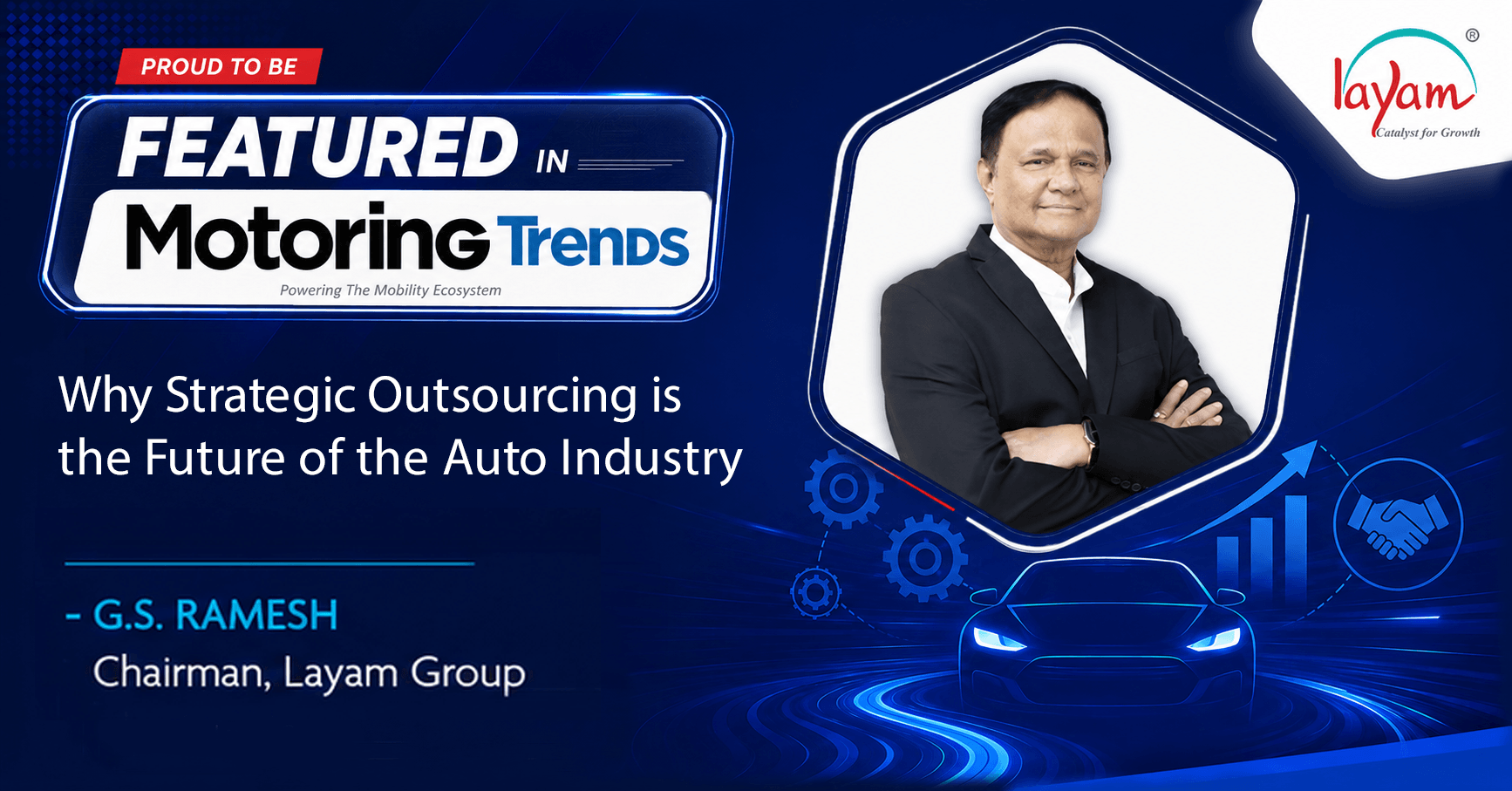
India’s automotive industry is entering a new era where strategic outsourcing, contract manufacturing and workforce solutions will increasingly become integral to how original equipment manufacturers (OEMs) operate, according to Layam Group Chairman G S Ramesh.
Speaking about the changing dynamics of automotive manufacturing exclusively with Motoring Trends, Ramesh said the industry’s transition from conventional vehicle production to electrification coupled with persistent cost pressures has accelerated the adoption of contract manufacturing models across the sector.
“India’s automobile industry is going through a unique transition phase. First there was the shift from conventional technologies, then the aggressive push towards electric vehicles followed by market fluctuations and uncertainty. In such an environment, OEMs are constantly looking at costs and human resources become one of the key areas where optimisation is possible,” Ramesh said.
According to him, modern contract manufacturing extends far beyond providing manpower and has evolved into an output-driven business model where service providers assume operational responsibility for specific manufacturing functions.
“Contract manufacturing is not simply about supplying headcount. It is about taking end-to-end responsibility for delivery. If an OEM expects a particular output, we must ensure it is achieved. Today, resource management and productivity enhancement are among the biggest challenges for manufacturers and they prefer partners who are willing to take ownership of these areas,” he explained.
The 20:80 operating model
Layam currently employs approximately 15,000 people and operates across nearly 60 locations nationwide.
Its footprint extends from Pantnagar in Uttarakhand to Chennai in Tamil Nadu, covering most of India’s major industrial hubs.
“We always prioritise local talent where possible. However, if specialised skills are unavailable, we mobilise resources from across India. In our organisation, you will find employees from West Bengal, Odisha, Jharkhand, Arunachal Pradesh and many other states,” noted Ramesh.
The company currently works primarily with OEMs and tier-I suppliers, although it has begun engaging tier-II suppliers and MSMEs to introduce them to its operating model.
At the heart of Layam’s approach is what Ramesh describes as a ‘20:80 model’.
Under this framework, OEMs contribute technology, infrastructure and capital investment, while Layam assumes responsibility for workforce mobilisation, execution and operational delivery.
“The OEM may have excellent technology and infrastructure but somebody still has to deliver the output. Our role is to provide the critical mass of skilled resources required to execute that vision efficiently,” he said.
The model also allows manufacturers to reduce long-term workforce liabilities while maintaining operational flexibility.
“If OEMs hire everyone directly, the costs continue to accumulate through salary increments, benefits and long-term obligations. Under a contract manufacturing model, resources can be redeployed as projects evolve. It eliminates the cascading effect of long-term liabilities while ensuring delivery,” Ramesh noted.
He added that strategic outsourcing also helps OEMs manage compliance and workforce administration more effectively.
“From statutory compliance to resource management, there is a comfort level when a specialised partner is handling these responsibilities,” the industry veteran noted.
Contract manufacturing
While some industry observers have raised concerns that contract manufacturing could eventually replace traditional employment within OEMs, Ramesh believes the future lies in collaboration rather than replacement.
“We are one part of the OEM ecosystem. We do not become the entire system,” he said.
However, he expects the role of outsourcing partners to expand significantly over the coming years.
“Today, the balance between in-house operations and outsourced activities may be around 60:40 or 70:30. Over time, it could move closer to 50:50. Strategic outsourcing is going to become one of the defining trends of the future,” he stated.
Looking ahead to 2030, Ramesh believes three factors will drive this transformation, namely cost, competence and consistency.
“Every OEM is under pressure to control costs. At the same time, finding and retaining skilled talent is becoming increasingly difficult. Consistency in quality also requires access to the right people and capabilities. Strategic outsourcing addresses all three challenges,” he contended.
Although contract manufacturing is often associated with production activities, Ramesh said the model is increasingly extending into engineering and research functions.
“Many people assume research and development remains entirely in-house but even these centres frequently utilise specialised talent supplied by third parties. We have supported organisations with highly specialised resources,” Ramesh observed.
At the same time, tangible production activities continue to represent the largest growth area for contract manufacturing.
Layam is currently involved in electric and conventional bus manufacturing projects for Tata Motors while also supporting operations at Ashok Leyland and conducting third-party quality inspections for multiple OEMs.
The company additionally manages supply chain operations, warehouse management, fabrication, welding, shell-building activities, paint shop operations and quality control assignments across various industrial sectors.
“We focus on process ownership and operational delivery rather than simply supplying manpower,” Ramesh said.
EV era
As India’s electric vehicle industry expands, workforce requirements are evolving rapidly.
Ramesh believes the shift presents significant opportunities for organisations capable of developing specialised skills.
“EV manufacturing is fundamentally different from conventional vehicle production. Areas such as wiring harnesses are becoming increasingly important,” he stated.
Layam has established partnerships with educational institutions and universities to support EV-focused training programmes and address the needs.
“We work closely with academic institutions to help develop relevant curricula and ensure graduates are industry-ready before entering projects,” he said.
The company also supports operations for major suppliers serving EV manufacturers including Japanese companies and leading component manufacturers.
Ramesh identified compliance management as one of Layam’s strongest differentiators.
With increasing scrutiny around EPFO, ESIC, workplace safety and labour regulations, he said companies can no longer afford compliance lapses.
“Execution excellence and statutory compliance are our biggest strengths,” he said.
Layam has invested heavily in digital systems that manage employee onboarding, workforce administration and compliance monitoring across all operating locations.
The company also operates a centralised control system from Chennai and maintains a dedicated compliance team.
“We have introduced a 24-hour employee helpline. Any worker facing an issue can contact us directly and we ensure that concerns are addressed quickly,” he contended.
The company additionally provides post-employment support for provident fund settlements and assists families in securing benefits following employee deaths.
Tackling attrition
Despite widespread concerns about workforce attrition, Ramesh believes retention is ultimately driven by trust and employee welfare rather than compensation alone.
“The younger generation has different expectations. They want faster growth and immediate outcomes, which naturally contributes to higher attrition,” he explained.
However, he believes organisations can build loyalty by addressing employees’ fundamental concerns.
“If you take care of three things, that is food security, medical support and family wellbeing, then people will remain loyal,” he noted.
Layam’s employee welfare initiatives include healthcare support, family assistance programmes and, in some cases, financial assistance for children’s education.
Much of Layam’s culture appears to stem directly from Ramesh’s personal management philosophy shaped during his two decades with the Tata Group.
The chairman maintains an open-door policy and encourages employees at all levels to approach him directly.
This philosophy also influences the company’s approach towards contract workers.
Consulting to manufacturing
Layam’s entry into contract manufacturing began in 2023 after years of operating as an HR consulting and workforce solutions provider.
According to Ramesh, the move emerged from a desire to create greater value for both employees and customers.
“Our original mission was to hire, train and deploy talent. Over time, I asked myself why we couldn’t convert that brain power into direct operational value,” he contended.
The decision has paid off.
“Contract manufacturing has been a major growth catalyst for us. We are currently growing at around 20 percent annually,” he stated.
As India’s automotive industry navigates electrification, cost pressures and workforce transformation, companies like Layam are positioning themselves not merely as staffing providers but as strategic partners embedded within the manufacturing ecosystem.